
15 April 2026
Workplace Accidents Caused by Stairs and How to Prevent Them
How Common Are Work-Related Stair Accidents?
Every year in Turkey, thousands of workplace accidents occur as a result of falls on stairs or carrying heavy loads on stairs. According to data from the Ministry of Labour and Social Security, a significant proportion of workplace accidents are caused by falls from heights and manual handling. Employees carrying heavy loads 67% is at risk of having a stair-related accident.
Each accident; on average 45.000 TL causes direct costs (treatment, compensation, lost workdays) and indirect costs several times higher (production stoppages, staff turnover, reputational damage).
The Risks of Carrying Loads on Stairs
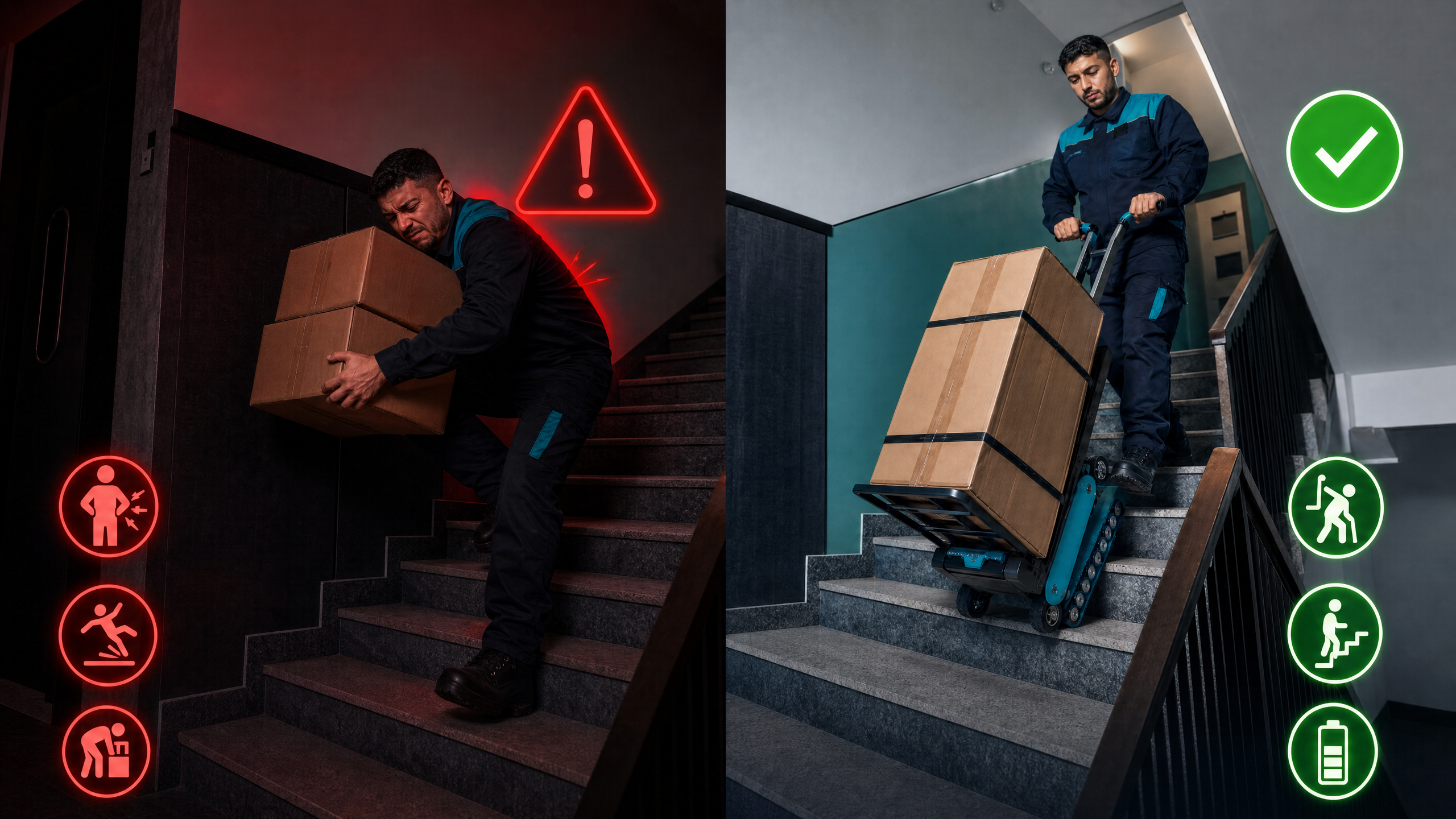
Manually carrying loads up and down stairs puts considerable strain on the body. Herniated discs, shoulder injuries and knee problems are among the most common occupational illnesses in this line of work. In addition, if balance is lost, both the person carrying the load and those nearby face a serious risk of injury.
- Lower back and spinal injuries: Heavy loads wear down spinal discs.
- Accidents involving falls: Load balance may be compromised on slippery or narrow stairs.
- Product damage: Falling loads can damage both personnel and products.
- Long-term occupational diseases: Repeated heavy lifting leads to chronic musculoskeletal disorders.
Safety in Mobility Assistance: A Distinct Risk Category
In addition to load handling, carrying wheelchair users on stairs also involves serious safety risks. Manually carrying a wheelchair by inexperienced staff creates a risk of falls and injuries for both the person being carried and the staff.
Designed to eliminate this risk AAT C-MAX U1, an automatically activated braking system on every step and patented Comfort Step technology takes safety in mobility assistance for people with disabilities to the highest level. Its safety-chip control system prevents unauthorized use, while the climbing legs' positioning close to the edges of the steps ensures maximum stability in all conditions. Developed in Germany, this safety architecture has made the AAT C-MAX a global standard in the category of mobility assistance for people with disabilities.
Reduce Risk to Zero with an Electric Stair Climber
Electric stair climber devices, lets the device carry the load instead of personnel. This means:
- Risk of workplace accidents at a rate of 90% decreases.
- Product damage at a rate of 95% falls.
- Risk of occupational illness and disability at a rate of 99% decreases.
- Heavy loads can be transported safely with a single operator.
Legal Obligations
Occupational Health and Safety Law No. 6331 requires employers to protect their employees from occupational risks. Risk assessments must be carried out and suitable technical equipment provided when transporting heavy loads on stairs. Load handling device for stairs using [it] is one of the most practical ways to fulfill this obligation.
Result
Work-related stair accidents can be prevented. Investing in the right equipment protects employee health and minimizes the business's legal and financial risks. our Risk Analysis tool You can use [it] to calculate stair-related risks in your workplace free of charge.